
Authored By: Allex Pellicano, CFA
A meaningful number of our clients hold employer stock through an Employee Stock Purchase Plan, and most understand the headline feature well: a discount, often fifteen percent, off the market price. Far fewer understand how that discount is taxed, or how differently the plan behaves depending on where the stock has traded during the months between enrollment and purchase. Both of those questions matter more than the discount itself when the time comes to decide what to do with the shares.
This piece walks through the mechanics of a qualified ESPP in plain terms, then spends most of its attention on the part clients ask about least and need most: what happens, tax-wise, when the stock has fallen since you enrolled. That scenario can be more common than the marketing materials suggest, and the way it plays out under the tax code is more nuanced than summaries may let on.
How the Purchase Works
A typical Section 423 qualified ESPP, the type most public companies use, runs on payroll deductions collected over an offering period, often between six and twenty-four months. At the end of that period, the accumulated contributions are used to buy shares automatically, at a price discounted from fair market value by up to fifteen percent, the maximum the tax code allows.
Many plans add a lookback provision, which bases the purchase price on the lower of two values: the stock's price on the first day of the offering period, or its price on the purchase date itself. This is the feature that gives ESPPs their reputation for outsized returns when a stock has risen sharply during the offering period, since the discount is applied to the earlier, lower price rather than the current, higher one.
The tax code also caps how much stock an employee can accrue the right to purchase in a calendar year: $25,000 of fair market value, measured on the offering date rather than adjusted for later moves in the stock. Most employer plans set their own, lower contribution limits well below that statutory ceiling.
Two Ways to Sell, Two Different Tax Outcomes
Once shares are purchased, no tax is owed yet. Tax is triggered only when the shares are sold, and how that sale is taxed turns on how long the shares were held.
A disqualifying disposition happens when shares are sold before meeting both of two holding periods: two years from the offering date and one year from the purchase date. In that case, the full discount captured at purchase, the difference between what was paid and what the stock was worth that day, is taxed as ordinary income. Any further movement in the stock's price between purchase and sale is taxed separately as a capital gain or loss, typically short-term.
A qualifying disposition happens when both holding periods are met. Here the tax code is more forgiving, but in a specific and sometimes counterintuitive way. The amount taxed as ordinary income is capped at the lesser of two figures: the actual gain on the sale, or a flat fifteen percent of the stock's price on the offering date, the discount computed as though the shares had been bought on that date at the plan's stated rate, rather than on what was actually paid once the lookback is applied. Anything above that capped amount is taxed as a long-term capital gain, generally at a meaningfully lower rate.
In a rising market, that cap tends to be small and favorable. Consider a stock priced at $100 on the offering date that climbs to $140 by the purchase date. With the lookback in place, the purchase price is 85 percent of the lower, offering-date figure: $85 per share. If the shares are later sold in a qualifying disposition at $160, the ordinary income is capped at just $15 per share, the gap between the $100 offering price and the $85 paid. The remaining $60 of gain is taxed as a long-term capital gain. Compare that to a disqualifying disposition on the same shares, where $55 of the gain would have been ordinary income instead of $15. The difference in character, not just the tax owed, is the entire point of holding for a qualifying disposition.
The Down-Market Wrinkle Summaries Can Miss
Here is where the picture gets more complicated, and where we think many clients are working from an incomplete understanding. When a stock has fallen during the offering period, the lookback still protects the discount: the purchase price is based on the lower, current price rather than the stale, higher offering-date price. That part works as advertised.
What does not change, and this is easy to get wrong, is the size of the cap itself. The cap on ordinary income for a later qualifying disposition is fifteen percent of the offering-date price, the same figure that applied in the up-market example above, whether the stock rose or fell during the offering period. What the lookback changes is how far below that reference price the employee actually paid, and because the purchase price is now well below the offering-date price, a comparatively modest gain at sale is enough to reach the cap.
Take a stock priced at $100 on the offering date that falls to $70 by the purchase date. The lookback bases the purchase price on the lower figure, so the employee pays 85 percent of $70, or $59.50 per share. The cap on ordinary income for a later qualifying disposition is still $15.00 per share, fifteen percent of the $100 offering price, the same figure that would apply had the stock not fallen at all. What has changed is that the employee paid only $59.50 for the shares, so it now takes far less appreciation at sale to reach that same fixed cap.
That low bar has a real consequence. If the stock partially recovers and is later sold at $75 in a qualifying disposition, the actual gain is $15.50 per share, just above the $15.00 cap. Because the cap binds almost immediately, nearly the entire gain is taxed as ordinary income, and only $0.50 per share receives long-term capital gains treatment, a far smaller share than in the up-market example above. The stock does not need to recover anywhere near the original $100 offering price for a capital gain component to appear; it only needs to clear $74.50, the $59.50 purchase price plus the $15.00 cap.
And if the stock does not recover at all, a different rule takes over. Say the same shares, purchased at $59.50, are eventually sold at $50 in a qualifying disposition, still below what was originally paid. The actual gain on that sale is negative, a loss of $9.50 per share, and the tax code does not assign a negative amount of ordinary income. In that case ordinary income drops to zero, and the full $9.50 shortfall is treated as a long-term capital loss instead, usable against other capital gains and, within limits, against ordinary income as well. This is the one scenario where the down-market cap works in the client's favor: a client does not owe ordinary income tax on shares sold below their purchase price.
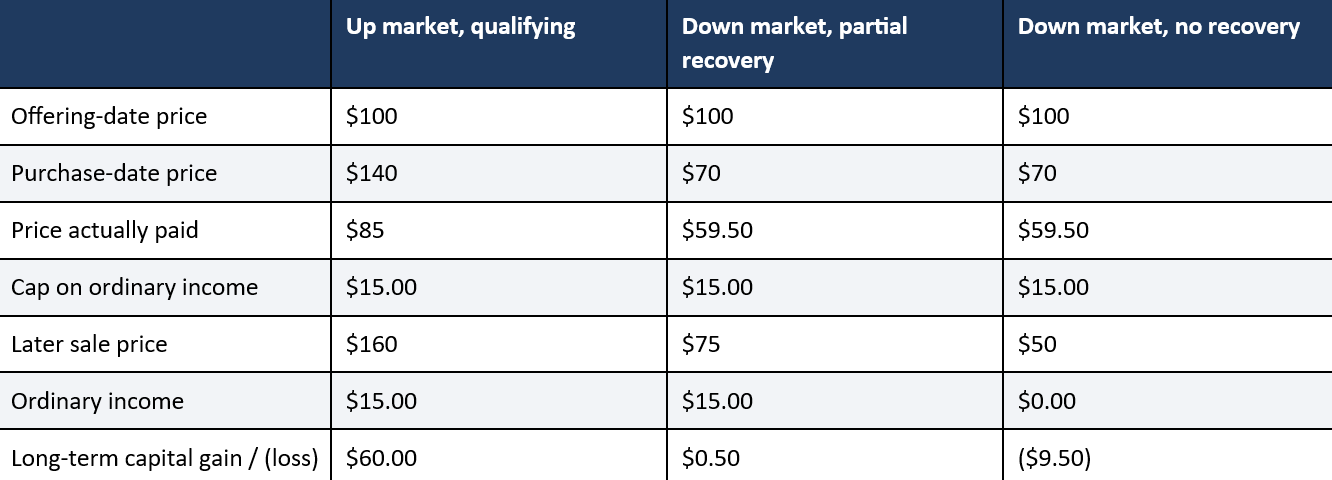
Laid out this way, the three cases tell a consistent story. The statutory cap itself does not move: it is fifteen percent of the offering-date price, whichever direction the stock traveled during the offering period. What moves is how far below that reference price the lookback actually took the purchase price, and that gap determines how little appreciation it takes to pin ordinary income at the cap. A client can end up with nearly the entire gain taxed as ordinary income on a modest recovery, a clean capital loss on no recovery at all, or, on a strong enough recovery, a growing share of the gain finally reaching long-term capital gains treatment as the fixed-dollar cap becomes a shrinking fraction of the total. The one constant across all three is the floor described above: ordinary income can shrink toward zero as the sale price falls, but it does not turn a loss into a taxable event.
The Same Shares, Sold Too Soon
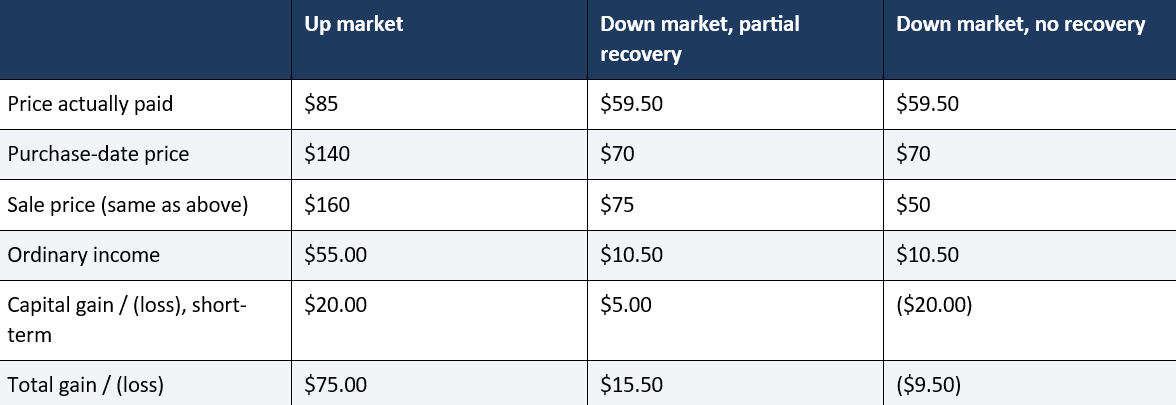
It's worth pausing on what would happen to these same three positions, purchased at the same prices, if they were sold before meeting the holding-period tests instead, a disqualifying disposition rather than a qualifying one. The comparison at matching sale prices is more revealing than either table on its own.
Figures are illustrative only and exclude commissions, fees and taxes and may not represent individual circumstances.
In the up-market column, the total gain is the same $75 either way, but the character shifts sharply: a qualifying disposition keeps ordinary income to $15 and treats $60 as long-term capital gain, while selling too soon turns $55 of that same gain into ordinary income and leaves only $20 as a short-term capital gain, taxed at ordinary rates anyway. This is the clearest, most familiar version of the qualifying-disposition benefit, and it is why holding period discipline matters most when a stock has risen.
The down-market columns tell a less familiar story. In the partial-recovery case, selling too soon actually produces less ordinary income than waiting for a qualifying disposition, $10.50 instead of $15.00, because the disqualifying disposition's ordinary income is fixed at the bargain element captured at purchase and does not grow as the stock recovers, while the qualifying disposition's fifteen-percent cap is measured off the full $100 offering price and is already exceeded by the time the shares reach $75. Waiting did not help in that scenario, and as the next section shows, it can be worse than not waiting at all.
The no-recovery column is the sharpest contrast of all. A disqualifying disposition still generates $10.50 of ordinary income, the fixed bargain element from the purchase date, even though the shares are ultimately sold at an overall loss of $9.50. That ordinary income sits alongside a $20 short-term capital loss rather than disappearing the way it does in a qualifying disposition. A qualifying disposition on the same shares, sold at the same price, owes no ordinary income and reports a smaller, cleaner $9.50 long-term capital loss instead. This is the real cost of selling a depressed ESPP position too early: not a larger tax bill in absolute terms, since the capital loss is larger to compensate, but ordinary income recognized on a position that lost money overall, which a qualifying disposition would have avoided.
When Selling Sooner Can Beat Waiting
The partial-recovery comparison above is worth stating as a general rule rather than a one-off result. For ESPP shares purchased during a down market, a disqualifying disposition is not automatically the worse outcome. Once the stock has recovered above the purchase-date price, it can be the better one, and the reason is mechanical rather than a matter of client preference.
The two dispositions cap ordinary income off different reference points. A disqualifying disposition fixes ordinary income at the purchase-date price minus the price paid, fifteen percent of the purchase-date price under a standard plan. A qualifying disposition caps ordinary income at fifteen percent of the offering-date price. When the offering period was a down market, the purchase-date price sits below the offering-date price, so the disqualifying figure starts out smaller than the qualifying cap and stays fixed, however far the stock later climbs.
The two figures are equal when the shares are sold at the purchase-date price itself, $70 in our example. Sell below that level and a qualifying disposition still wins, since its ordinary income tracks the smaller actual gain rather than the fixed disqualifying figure. Sell above it, as in our $75 example, and the disqualifying figure remains the smaller of the two, since the qualifying cap is anchored to the higher offering-date price.
There is a further wrinkle that makes this more than a marginal difference. The qualifying-disposition test and the ordinary short-term-versus-long-term capital gains test run on separate clocks. A sale can fail the ESPP-specific two-year offering-date test, making it a disqualifying disposition, while still clearing the general one-year purchase-date test that governs long-term capital gains treatment. Held past that one-year mark but sold before two years from the offering date, our $75 example produces $10.50 of ordinary income and a $5.00 long-term capital gain, both figures better than the $15.00 of ordinary income and $0.50 of long-term capital gain a fully qualifying sale would produce on the same shares at the same price.
This reversal is specific to purchases made during a down market. When the stock rises over the offering period, as in the up-market column throughout this piece, the ordinary logic holds and a qualifying disposition remains the more tax-efficient choice. The practical takeaway is that the purchase price relative to the offering-date price, not the length of time already held, is what should drive whether waiting out the full qualifying-disposition clock is worth it on a given lot.
Weighing the Trade-Offs
None of this changes the basic case for participating where a plan is available. The combination of a mandatory discount and a lookback provision produces a return profile that may be favorable relative to the market risk involved, and the payroll-deduction structure builds a savings discipline that many clients wouldn't otherwise maintain. Shares can typically be sold immediately after purchase, which means the discount can be captured in cash without taking on lasting exposure to a single company's stock.
The trade-offs run in the other direction. Employees already carry concentrated exposure to their employer through their paycheck, and adding equity on top of that compounds the risk rather than diversifying it. Funds are generally illiquid for the length of the offering period, and the tax reporting carries a well-known pitfall: brokers typically report cost basis on Form 1099-B without adjusting for the ordinary income already taxed through payroll, which can lead to that income being taxed twice unless it is corrected on Form 8949 using the details from Form 3922.
A Note on Non-Qualified Plans
Not every ESPP is built under Section 423 of the tax code. Some employers run non-qualified plans instead, often to offer a deeper discount, a longer offering period, or eligibility limited to a specific group of employees, none of which the qualified structure permits. The tax treatment is materially different: the full discount is taxed as ordinary income immediately at purchase, subject to income tax withholding and, unlike a qualified plan, to Social Security and Medicare taxes as well. There is no qualifying or disqualifying disposition distinction in a non-qualified plan; once the ordinary income is recognized at purchase, any further movement in the stock is a standard short-term or long-term capital gain or loss.
How We Approach ESPP Shares
When we review a client's ESPP holdings, the decision of when to sell rarely comes down to the discount alone. We look at where the purchase price sat relative to the offering-date price, since that single fact determines how wide or narrow the ordinary income cap will be on a later sale. We weigh that against the client's tolerance for concentration in a single stock, their marginal tax bracket in the year a sale would occur, and their liquidity needs more broadly. A client sitting on ESPP shares purchased during a downturn may be better served by a different plan than one whose shares were purchased near a market high, even though both are participating in the same benefit.
If your household holds ESPP shares and you would like us to walk through what a sale would look like under your specific numbers, we are glad to do that as part of a broader portfolio review.
This material is for informational purposes only and does not constitute *tax*, investment, or legal advice. Individual circumstances vary, and clients should consult their tax advisor before acting on any of the strategies discussed here.